Learn
Each lesson is a small, isolated setup in the same C physics. Run one, watch, then change one number.
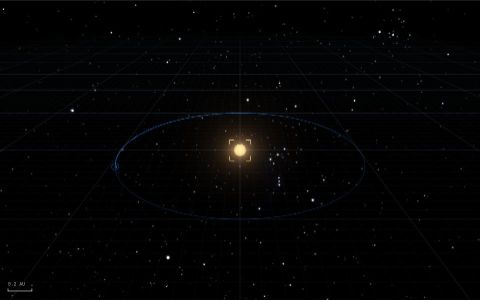 Why does an orbit curve?
Earth on a circle. Turn on vectors: velocity is along the path, the pull points at the Sun.
Run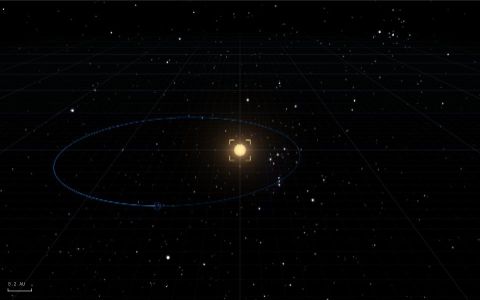 Why does a planet speed up near the Sun?
An orbit with e = 0.5. Watch speed rise at perihelion and fall at aphelion.
Run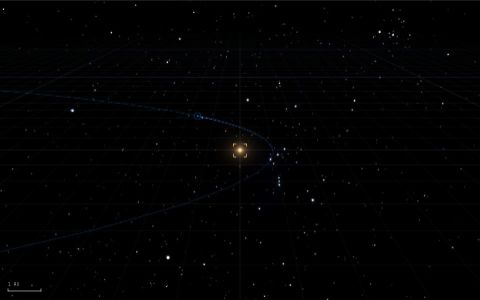 How fast is fast enough to leave?
Start at escape speed. Lower the speed factor below 1 and the orbit closes again.
Run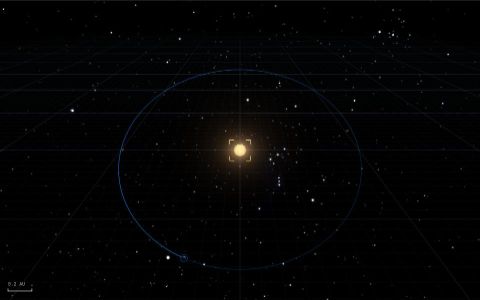 What does a tilted orbit look like?
A 30° inclination. Rotate the camera to see the orbit cross the ecliptic.
Run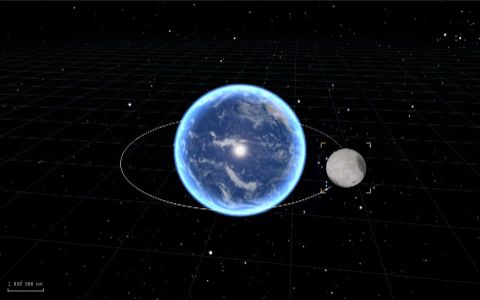 Do Earth and the Moon orbit each other?
Both circle their barycenter, 4,700 km from Earth’s centre.
Run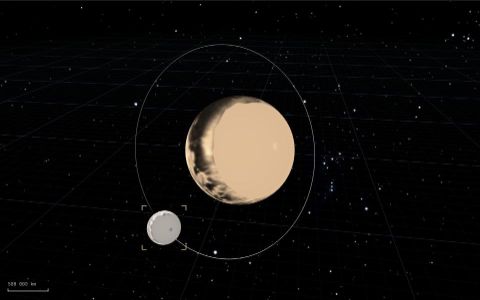 Can a world orbit empty space?
Charon is 12% of Pluto’s mass: their barycenter lies outside Pluto.
Run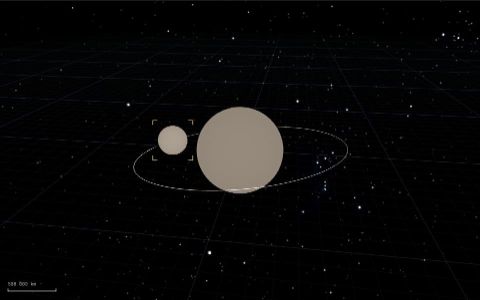 How did DART move an asteroid?
Set Speed × to 0.985 and Load: the period readout drops by about half an hour, as it did in 2022.
Run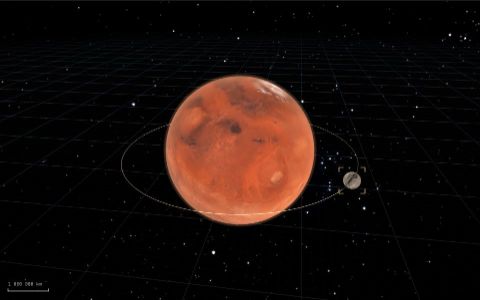 How small must a step be?
Phobos loops Mars every 7.7 hours. Raise the step and watch the phase drift.
Run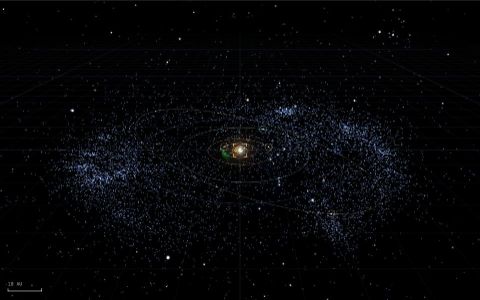 Does the Sun move?
The full scene with a free Sun: it wobbles around the solar system’s barycenter.
Run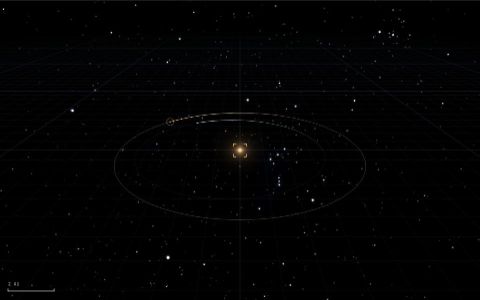 What is a 3:2 resonance?
A particle that circles the Sun three times for every two of Jupiter’s.
Run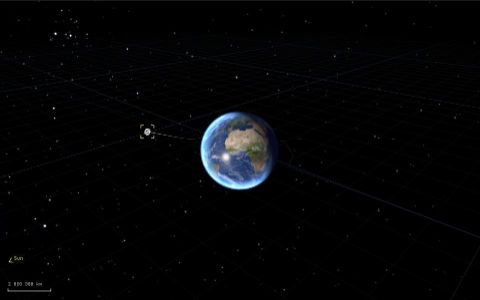 What does a close flyby do?
A probe passes Earth at 10 km/s. Its path bends; Earth barely notices.
Run What happens when two bodies touch?
Two spheres meet head on. Switch Contact between bounce and merge.
Run
Look from Earth
The same simulation, seen from Earth's centre through a telescope field. Each link plays the sky to its night first.
- Venus as a crescent: 5 October 2026, three weeks before it passes between Earth and the Sun: 11% lit, 51 arcseconds wide.
- The waxing gibbous Moon: 25 June 2026: 125 degrees from the Sun and 79% lit.
- Jupiter in the night sky: 1 December 2026, 103 degrees from the Sun: its banded disc is 38 arcseconds across, with the four Galilean moons strung along a line.
- Saturn's rings opening: 15 January 2027, two years after they were edge-on: the rings tilt open again.
Compare two runs
Run the same setup twice with different steps, methods or speeds and plot the difference. Open the comparison lab.
Lessons change the rules
Lessons start from simple invented states (circles, perihelia) and keep planets as point masses so their analytic answers apply. The main scene is different: it starts from the real sky of 2026-06-09 with planetary J2. Each lesson can switch between Verlet and Euler and choose its step; the comparison lab and solar-lab CLI export the same numbers as CSV.